
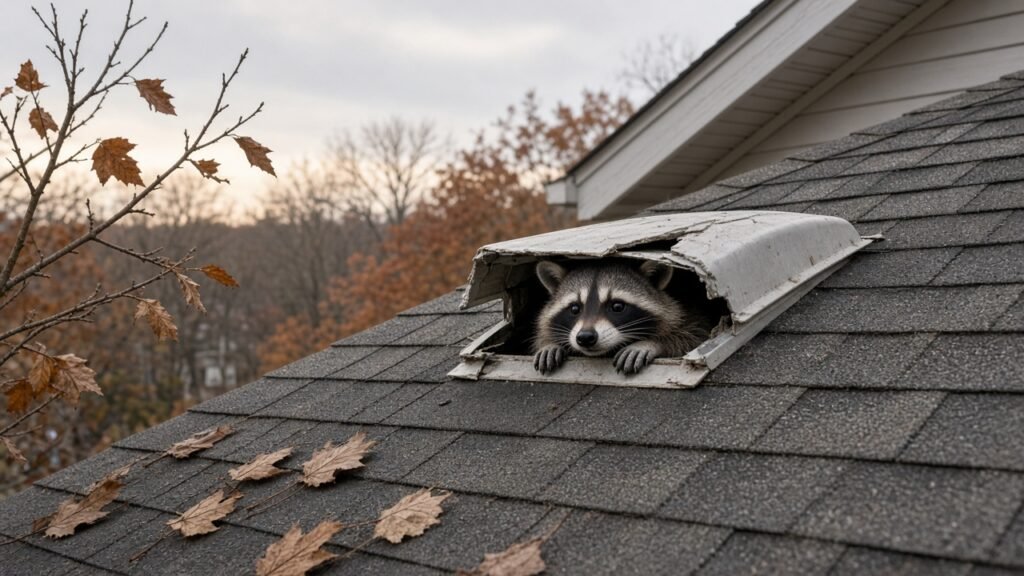
If you are hearing noises in your attic this November, the time of day is your best clue. Heavy thumping or walking late at night usually points to a raccoon. Quick scurrying or rolling sounds in the early morning and late afternoon usually means squirrels. Light, steady scratching inside walls or ceilings after dark is most often mice.
Whatever it is, do not seal the hole you think it is using until you know the animal is out. Closing an animal inside your attic is the most common and most expensive mistake we see. If you want a fast answer, call Barrie Pest Control at (705) 812 1412 for a free inspection.
Why attic noises pick up in Barrie in late fall
Once nights get cold in Barrie and across Simcoe County, wildlife and rodents look for dry, warm, quiet shelter. An attic gives them all three. Mature trees near rooflines, older homes with worn soffits, and easy food like bird seed and unsecured green bins make many Barrie neighbourhoods an easy target.
Late fall is also when small gaps get tested. A roof vent that a squirrel chewed in September, a loose soffit corner, or an uncapped chimney can turn into a winter den by December.
How to tell what is in your attic
Spend one or two evenings paying attention before you do anything. Write down when the noise starts and stops, and what it sounds like. That alone narrows it down a lot.
Raccoons: heavy, slow and at night
- When: after dark, often a burst of noise around dusk when they leave and again before dawn when they return.
- Sound: heavy footsteps, thumping and dragging. It can sound like a person walking in the attic.
- Other signs: a torn roof vent or soffit, lifted shingles, flattened or soiled insulation, and droppings piled in one spot (raccoons use the same “latrine” over and over).
Squirrels: fast and busy, mostly in daylight
- When: early morning and late afternoon. They usually leave in the morning and come back later in the day, and are mostly quiet overnight.
- Sound: quick running, scratching, chewing, and a rolling sound as they move and store food.
- Other signs: chewed edges on soffits, fascia or vents, squirrels on the roof, and nesting material poking out of a vent. Squirrels also chew wiring, which is a fire risk.
Mice: light and steady, inside walls and ceilings
- When: at night, sometimes at a similar hour each night.
- Sound: light pattering or scratching, more often inside walls than across the attic floor.
- Other signs: small, dark, rice-sized droppings in insulation, along basement walls, or near the furnace and under sinks. Our guide to rodent problems in Barrie covers mouse and rat signs in more detail.
Quick comparison
| What you notice | Most likely |
|---|---|
| Heavy thumping or walking at night | Raccoon |
| Running, rolling or chewing at dawn and dusk | Squirrel |
| Light scratching inside walls at night | Mice |
| Droppings in one repeated pile | Raccoon |
| Small droppings scattered widely | Mice |
| Fresh chew marks on vents or soffits | Squirrel |
If you are still unsure, take a short phone recording of the noise with the time on it, and a photo of the roofline from the ground. That helps a technician tell you what you are dealing with before they arrive.
What not to do
A few common moves make the problem worse or break the rules in Ontario.
- Do not seal the entry hole yet. If an animal is still inside, it will chew a new way out, often through your ceiling, or die in the attic.
- Do not trap and drive the animal across town. Under Ontario’s rules for protecting your property, a live animal that is captured must be released within 1 kilometre of where it was caught, and within 24 hours. The province explains this on its page about dealing with wild animals damaging private property. Moving animals farther away can also spread diseases such as rabies or distemper.
- Do not use poison on wildlife. It is not a humane option, and a poisoned animal can die inside your walls or attic.
- Do not handle droppings with bare hands. Raccoon droppings can carry raccoon roundworm. The BC Centre for Disease Control notes that the eggs become infectious after two to four weeks and can survive in soil for years. If you must clean a small area, wear gloves and a mask and double bag the waste.
- Do not crawl around a dark attic alone. Loose flooring, exposed nails and a defensive animal are a bad mix.
What to do instead: a safe step-by-step
1. Walk around the outside of your home
From the ground, check roof vents, soffit corners, the fascia, the chimney, and where the roof meets a wall or garage. Look for chewed edges, bent vent covers, gaps, and nesting material. Note any branches touching the roof, since they act as a bridge for squirrels and raccoons.
2. Remove what draws them in
The Ontario government recommends making your property less attractive before removing any animal. That means:
- Secure garbage and green bins.
- Take down or clean up under bird feeders.
- Pick up fallen fruit and do not leave pet food outside.
- Block access under decks, porches and sheds.
3. Make sure the animal is out before you close anything
This is where timing matters. The Toronto Wildlife Centre advises that a raccoon living in an attic between January and September should be assumed to be a mother with babies. It also notes that one-way doors are a good option from October to December, when tiny baby raccoons are unlikely. In other words, right now is one of the better times of year to get a raccoon out humanely.
A simple check is to loosely stuff the entry with crumpled newspaper and wait a few days. If it stays in place and the attic is quiet, the animal has probably left.
4. Seal it properly, not just quickly
A temporary patch is not a fix. Squirrels can chew through plastic vents and thin materials, so entry points need sturdy exclusion work, such as metal vent covers and mesh, and the rest of the roofline should be checked too. Animals often test other weak spots once their main door is closed.
5. Deal with the mess
Raccoons and squirrels can tear, flatten and soil insulation. Depending on how long they were there, the attic may need cleanup and sanitizing before it is back to normal.
When to call a professional
You can handle small prevention jobs yourself, like trimming branches and securing bins. Call a professional when:
- You hear heavy movement at night and suspect a raccoon.
- The noise continues after you think the animal left.
- The entry point is high on the roof or hard to reach safely.
- You find droppings, torn insulation or chewed wires.
- You hear noise in more than one area of the house.
Our wildlife removal service covers humane removal of raccoons, squirrels and skunks, inspection of entry points, sealing and exclusion to prevent re-entry, cleanup and sanitation, and advice to keep animals out long term. If the noise turns out to be mice, our mice and rat control service includes an inspection, entry-point work and follow-up visits.
We also offer free inspections, same-day or next-day service in most cases, and emergency response when you need it. Our vehicles are unmarked for your privacy.
Serving Barrie and Simcoe County
We help homeowners with attic wildlife and rodents across Barrie, Innisfil, Orillia, Bradford, Wasaga Beach, Newmarket and Vaughan. See all of our service areas.
Hearing something in the attic tonight? Call (705) 812 1412 or request a free quote and we will help you find out what it is and get it out safely.
Frequently asked questions
What animal makes noise in the attic at night?
Heavy walking or thumping at night is usually a raccoon. Light scratching at night, especially inside walls, is usually mice. Squirrels are mostly active in the early morning and late afternoon, so noise in the middle of the night is less likely to be a squirrel.
Can I trap a raccoon or squirrel and release it somewhere else?
Not far away. Ontario’s rules say a live animal captured to protect your property must be released within 1 kilometre of where it was caught and within 24 hours. Because of this, removing the animal and sealing the entry is usually the better long-term fix.
Is it safe to remove raccoons from an attic in November?
Late fall is generally one of the better times. The Toronto Wildlife Centre notes that one-way doors are a good option from October to December, when very young baby raccoons are unlikely. From January to September, assume a mother with babies may be inside.
Are raccoon droppings dangerous?
They can be. Raccoon droppings may carry raccoon roundworm eggs, which can cause serious illness if swallowed. Avoid touching them, keep kids and pets away, and wear gloves and a mask if you must clean up a small area.
How do I keep animals out of my attic for good?
Find and seal every entry point with sturdy materials, cap the chimney, cover roof vents with metal guards, trim branches away from the roof, and remove food sources like bird seed and open garbage. A professional inspection can spot weak points you cannot see from the ground.
How much does attic animal removal cost in Barrie?
It depends on the animal, how many entry points need sealing, and how much cleanup is needed. We offer free inspections and estimates so you know the cost before any work starts. You can also read our pest control cost guide for Barrie.